
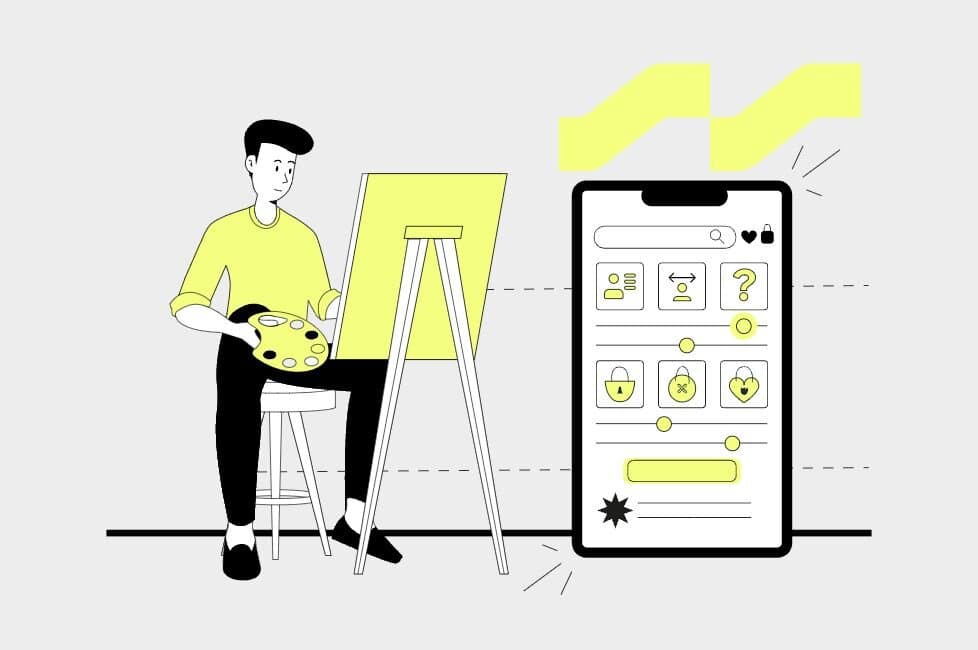
The power of personalisation in e-commerce

It is always good to look at the data in order to make some sense of the project. 54% of users expect products and content tailored to their tastes and interests when they enter a shop. 65% of shops admit that their conversions increased after the introduction of personalisation. Moreover, 83% of people are willing to share personal data to receive a 'personalised experience'. What exactly is personalisation in e-commerce?
It is clear that the investment in personalisation will firstly pay off quickly. Secondly, it is something that half of customers expect. It enables some kind of exchange transaction between the brand and the user. OK - you give us the data. Despite, we won't just use it to put you in a box with a badge such as '25-year-old woman from a big city', where we already have X similar women. We will create a unique experience not for all the women in the box but for each individual woman. We want to use all the collected data we have for this. I mentioned that it's a transaction - so what will the client get in return? Maximum time savings. It's not just about shortening the path from entering the shop to displaying the product.
In fact, we can retain any information the customer has ever given us before. And how we want to personalise the experience is actually more often limited by our imagination than by our technical capabilities.
So how do we think about personalisation in e-commerce to harness its power?
It is well known that with customer data, we can go for the simplest form of personalisation. Address him by name, display a personalised thank- you note for the transaction, emails, remember what he types into the search engine, etc. What I would like to highlight is the ability to compile all this information we have into one personalised experience. Sometimes it will focus only on evoking positive emotions in the user, but sometimes it will focus on maximising functionality.
Let me return for a moment to the '25-year-old woman from the big city' mentioned earlier. In a project for a major brand producing products for children and young parents, we took the simplest step. Right after registration, the user can add the number of children, age and gender. Of course, the data question is 'sprinkled' with the information that this is all in order to personalise their experience as much as possible. We then prepared the homepage in such a way that, from now on, it shows products that are relevant to the children they have. No more fumbling through categories and filters. This had a significant impact on conversions!
In addition, we juxtaposed the above survey with the history of products viewed and purchased. Now, not only were we displaying age- and gender-appropriate products. We were also suggesting products that matched the colours of the products already purchased, as well as complementary products. For convenience, we added filters to the product carousels so that you can browse the suggestions for each individual child. This led to a situation where most customers bought directly from the shop's homepage. Alongside the products, we showed videos and blog posts aimed at parents of children of that particular age. This not only increased conversions but also kept bounce rates to a minimum.
Personalisation in e-commerce a step further
Personalisation in e-commerce can go even further. In principle, we can remember all the choices a user has made in the shop. On this basis, help them by suggesting products to buy. The idea of choosing one's own size for every product in the fashion industry is, in fact, logically unfounded. If a customer has ever chosen a size before when buying a product of a particular brand, there is in principle no need to force them to choose again. We can automatically select the most recently selected size on the product card. We can show products recommended only in his or her size and negate the so-called 'Frictions'. The friction when the customer finds out that OK - the shoe is nice, but my size is not there. This can and often does have a negative impact on conversions.
And finally, following the example of Zalando - we can analyse not only choices but also returns. If I return an item and the reason for the return is the wrong size, the system remembers this. Next time starts to suggest sizes on its own. A message appears, like 'for you, we suggest size M, although you usually wear L'. Personalisation in this area makes it possible to show products from different brands in theoretically different sizes but still fitting a given figure. This type of personalisation is the most desired by the user. He receives the product before he even thinks about what will actually be suitable for him.
Personalisation of the interface based on choices
In principle, each industry can use personalisation in a different way. I have talked a little about the possibility of proposing relevant products for parents and fashion devotees. There are, however, industries where emotions are the most important. Any car fan will admit that buying a car involves disproportionately different emotions than buying shampoo or shoes (although perhaps here some women will disagree). In one project for a major automotive brand, we carried out research with a worrying result. Buying a car online is losing its emotional character. On the other hand, a greater proportion indicated the importance of emotions during such a purchase. So how can we use personalisation to influence emotions?
The project concerned the sale of a specific new car model entering the market. A configurator was part of the process. Upon entering the site, the user saw a universal video and images of the said model. However, if he or she configured the car, the graphics and video were selected on the basis of the choices made, to maximise the representation of the car in the configurator. Users clearly indicated the 'wow' effect. From now on, the whole service turned into an advertisement for a maximally customised product. Customers did not have to use additional search engines to see a video of the car in the selected colour or with the selected rims. In addition, information about the configured car was used in retargeting.
The adverts, which followed the user, also featured a car similar to the one in the configurator. This made it possible to increase the emotional charge by presenting the product in the best possible configuration per individual user taste.
Can we personalise the price?
52% of users want personalised offers based on data from the loyalty programme. Undoubtedly, the main advantage of participating in such a programme is the possibility of receiving a discount. Many factors indicate that personalisation will continue. We will reach a point where customers not only expect a personalised offer, but also a personalised price. With maximum time savings, without the need to exchange points or enter codes. The trend indicates that the user will be able to see personalised prices. It will be based on their level of loyalty, immediately after logging in. This seems to be the pinnacle of offer personalisation. In my opinion, it is only a matter of time until online shops go down this path.
What is the future of personalisation in e-commerce?
With the ability to collect data about the customer, their choices, the products they browse, their purchase history, we can transfer their 'online' profile to physical shops. The ideal world would be one in which a given customer walking past a physical shop gets a 'push' message that reads. 'Hey Janek! You're near our shop - we have the product you recently viewed online in promotion!'. Better still, we identify the user at the entrance to the physical shop. Then the salesperson on the tablet can see what the user has viewed in the shop. Consequently, what products they can recommend.
To conclude
In conclusion, personalisation in e-commerce can take many forms. From simple personalised messages to the customer, to complex product suggestion logics, integrations linking user choices to return processes. It can also be a means of evoking positive emotions or appropriate retargeting. However, regardless of the brand or the budgets at our disposal, we should all be thinking about how to reach customers with products that meet their needs. Heuristics say that we have 7 seconds to get a customer interested in our product. Without personalised content, this is impossible.