
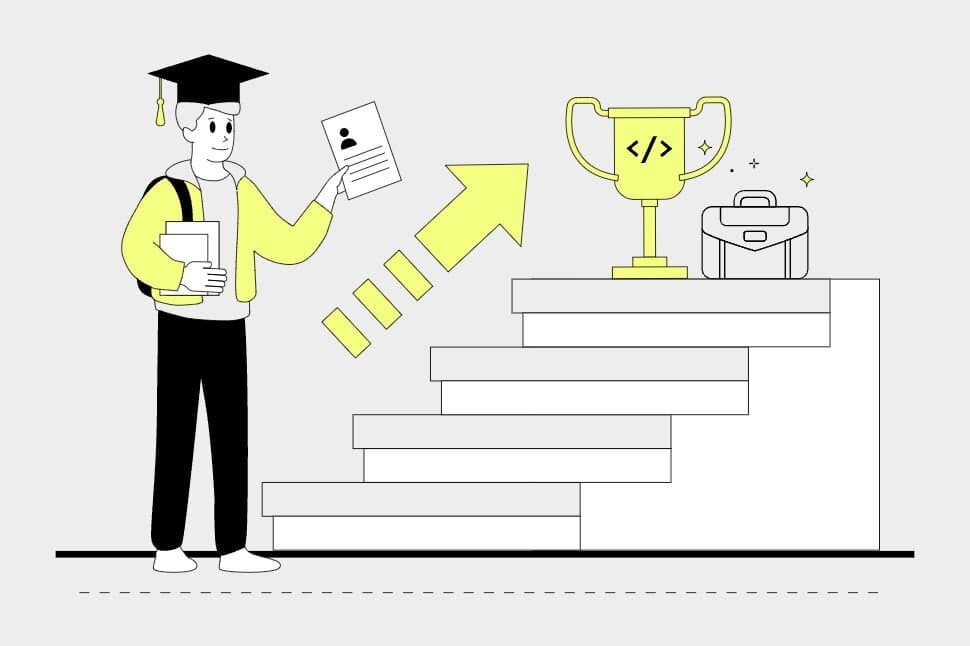
First job in IT - what should you know?

Still studying computer science but already want to start a career in IT? Would you like to have a flexible schedule that you can combine with your university? Do you want to work remotely while expanding your existing knowledge on real projects for real money? I guarantee you that it is possible. I used to be in your situation. I know how to do it even though it sounds abstract, but it is within reach
How do you prepare for your first job interview?
To start, I'd like you to answer the question of whether you prefer to be a frontend or backend developer. What is the frontend responsible for and what is the backend responsible for? In the simplest terms, the frontend is what the user sees. That is, the frontend developer is responsible for the implementation of the designed user interface and the interaction of that interface with the user. The backend developer, on the other hand, is responsible for the implementation of the business logic, database and integrations. A developer who can work on the frontend and backend is called a full-stack developer. To start with, I would advise against developing towards fullstack. That will come later, once you have become an expert in one path
After choosing frontend or backend, the first question you probably ask yourself is which programming language should I choose? Personally, I recommend trying a number of them. There will certainly come a time when you will write "hello world" in most languages, but at the initial stage you will not be able to tell which programming language will suit you best. It's hard to fall in love at first sight, but there's no denying it - some infatuation can set in
OK, so where do you start? After all, this decision will direct your career. When it comes to the front end, I would suggest starting with HTML, CSS and JavaScript. On the other hand, when you set your sights on the backend, I recommend PHP, Python, .NET or Java. Each of these languages is well described and documented in online resources. If you can't decide, flip a coin. And then check out each one next. Remember, coding can be monotonous at times, but the rule is simple-you have to like what you do.
Practice makes perfect
The next steps you need to take to become a programmer is training. As with everything we do- training makes perfect. Set yourself a time that you can dedicate daily or weekly to learning programming and follow your plan. Your time is an investment in your future. You can learn from free materials available on Youtube, books in libraries or free materials found on Google. Maybe you are currently studying your chosen programming language? This will be enough to get you started. I also highly recommend Udemy, where you can buy really good training courses at an affordable price. Personally, I would advise against attending all sorts of expensive programming training courses, from which I guarantee you won't get any more than you can from the available and free materials on the internet. The most important thing in programming is to learn systematically and get into the habit of thinking analytically!
OK, you are already learning systematically, but what next? How about that job for cool money? Once you have gained an elementary knowledge of programming, I see two paths. Try to find the perfect internship for you, an example is an internship at Monogo. You can find all the information at the link www.monogo.pl/staze. By going for an internship, from the beginning you have access to mentors - colleagues who may have already lost all their hair solving programming problems. It is under their guidance that you will learn good practices. The internship will also definitely fit into your degree programme, as you have to do an internship/guardianship in your first degree to pass the degree. So you have baked two birds with one stone
Your practical CV
The second option is to create your portfolio. You should set up a github account as soon as possible and upload your code there. Systematic learning is one thing, the second step is your code. Your future employer can check your progress, internal projects and sometimes ask recruitment questions based on that. I have hired many Junior Developers in my life, focusing mainly on the candidate's github. Think of Github as your CV and a gateway to the IT world. It is on it that you will prove that you are not only a theoretician but also a practitioner.
When to apply for a junior developer position?
I think that once you've worked your way through the documentation of a particular programming language, a course on Youtube or Udemy and completed two or three micro-projects for the 'drawer', you can confidently start sending your CV to IT companies. You will find plenty of advertisements on various job portals
Are you still a student and not sure if you can combine your studies with a job? I answer you straight away, it's not a problem. The pandemic has significantly changed the IT world. Remote working and flexible working hours have become standard. Browsing through the advertisements, you are bound to come across many of them where you can have flexible working hours. But remember - look for a job that is conveniently located for you, preferably in the same city where you live or study, because working in an office with mentors, you simply learn faster, whereas working remotely in the first stage of your career, may slow down your development
Recruitment interview
What should you know before such an interview? At Monogo, there are usually two stages of recruitment, the familiarisation stage, known as the soft stage, where you will have an initial meeting with someone from the HR department, and the second hard stage is the technical interview. How do you prepare for both stages? Regarding the soft stage, get to know the company's values, learn about its history, its project portfolio. You can find a lot of this kind of information on company blogs such as here. At this meeting, you can get a feel for whether the company you are applying to meets your needs and whether it is broadcasting on the same 'waves' as you. The second stage tests your technical knowledge. You will certainly be asked questions related to the technology of the position. It's worth looking for sample recruitment questions online beforehand. Often people post on various forums what questions were asked at their interviews, so you will know sample recruitment questions. At a technical meeting you may also be asked to solve a quick programming problem to prove your skills. Remember, at both stages of recruitment, be yourself, show your passions and values, don't pretend to be someone you are not because you are applying to a company where you plan to leave a part of yourself. You probably don't want to pretend to be someone you're not in it...
If you're looking for a job as a programmer, remember that learning, your own projects, a well-crafted github and CV will help you become a programmer. Also, take heart in the fact that a career in IT is all about continuous learning and development. New technologies, frameworks are constantly emerging and you need to be ready to continuously learn. Continuous development will allow you to move up the ladder faster and earn more. If you can do this on your own, so much the better, but if there is a senior developer in your path, take valuable advice from a more experienced colleague or friend.
I hope I've shown you at least a little bit about how to start your career. Now it's time for you to make your move! Good luck!